At Hightown of Craigs Farm, just south of Dumfries, Edward Martin helps run a mixed operation of 180 dairy cows and 120 beef sucklers alongside his parents and brother. With so many young calves to manage every year, feeding was one of the most time-consuming tasks on the farm when calving season hit.
"Previously, we were feeding wiht a milk car on teat feeders," Edward explains, a routine that took close to two hours each day. Last year, after seeing the JFC Evolution Automatic Calf Feeder at the UK Dairy Expo in Carlisle, Edward arranged a site visit before making the switch.
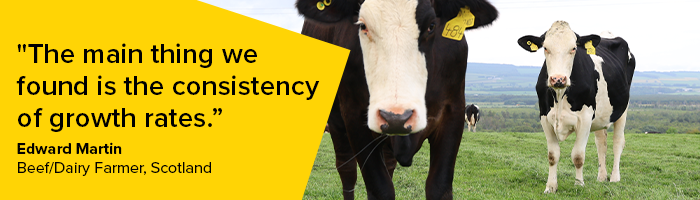
Four batches of calves have now gone through the system, and the benefits were noted immediately. Time has been freed up for management, the shed is calmer, and calf performance is noticeably more consistent.
As Edward puts it, for a family business, the feeder has "saved us so much more time with labour."
One of the earliest difference Edward has noticed since adopting the automatic calf feeder is the behaviour of the calves themselves. The shed used to get chaotic the very moment someone walked in with milk. Now, the calves stay settled and content.
"Previously, when you walked in a shed in the morning to feed them, it would just erupt," he recalls. "They would all be roaring. Now we go in and they're all content and happy every morning."
With every calf receiving the right volume, concentration of powder, and temperature of milk, growth rates have consistently improved across the board. Edward doesn't have to mix manually, and he can tailor feed curves. The results are visible. Calves are brighter, weaning is quieter, and post-weaning performance has strengthened too.
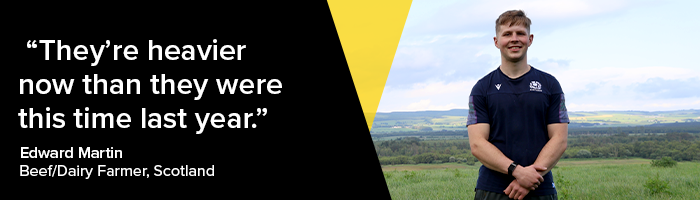
As Edward notes, "We actually weighed them today and we know that they're heavier now than they were this time last year."
Alongside calmer calves, one of the biggest shifts for the Martins has been the accuracy of feeding. With manual mixing and group teat feeders, there can be a degree of variation, whether it's slight differences in concentration, calves pushing one another, or stronger calves taking more than their share (and vice-versa).
The automatic calf feeder removes that uncertainty.
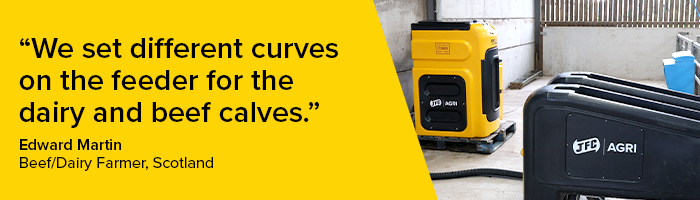
Each calf receives the exact volume and concentration set for it, every single time. Edward can assign different feeding curves to his herd, increasing or decreasing allocations gradually and consistently.
"We set different curves on the feeder for the dairy and beef calves," he explains. "The dairy calves, we can keep them on for longer and feed them more milk."
Every feed is logged, every drop is accounted for, and any deviation shows up immediately on the HMI touchscreen. A red X signals that the calf hasn't fed, amber highlights calves that haven't taken their full allocaiton, and when all calves have fed, the screen fills with green ticks.
This traffic light system eliminates guesswork, so there are no assumptions, and no calf slips under the radar.
The precision of the automatic calf feeder doesn't stop at the touch screen. A major advantage is being able to keep track of the calves without having to be physically beside the unit.
Edward uses the mobile app to access the information when he's on the move. It gives him a clear snapshot of each calf's activity, showing who has fed, who hasn't taken their full allowance, and who might need a closer look. It uses the same familiar colour-coded system as the control unit.
"I can check and see which calves haven't been in," he says. "If I'm off farm, I can look at the app and make sure whoever's doing the calves is pushing the right ones on."
This flexibility matters. Calving season isn't always tidy. Routines shift, nights run late, and farmers are often pulled in different directions, whether it's other work on the farm, business commitments, or even a day away at a show.
The app gives Edward the freedom to step away without wondering what's happening in the shed. He can see, in real time, which calves have fed and which need a push, keeping everything on track even when he's not there to check for himself.
Weaning has been one of the clearest markers of progress for Edward's calves. Instead of the disruption that often comes with reducing milk, the automatic calf feeder tapers calves off gradually through their individual feed curves. As many farmers report, you hardly notice they've come off milk at all.
That controlled step-down keeps calves calm and avoids the usual stress associated with traditional weaning methods. With no sudden changes in routine, they push on immediately and maintain a clear shine and maintain a clear shine when driving into the next stage of growth.
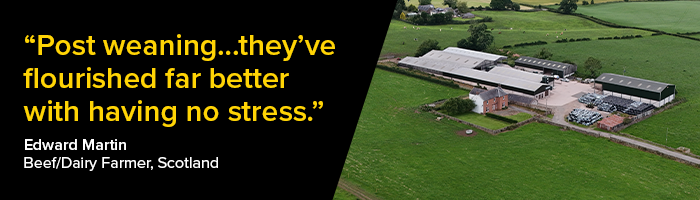
For Edward, the difference post-weaning has been easy to see. The calves are heavier than at the same stage last year and they're flourishing with the steadier, low stress start that automation provides.
After several groups of calves on the system, Edward has clear pictures of what automation is delivering. The shed runs with far less interruption, the pressure around feeding has eased, and the calves are progressing through each stage without setbacks.
Improved weight gain: Calves are ahead of last year's figures.
Smooth transitions: Weaning happens quietly with no stress.
Reliable routines: Feeds are consistent, even when Edward is off farm.
More time available: Labour can shift totwards other jobs that drive the farm forward.
Are you considering a move to Automatic Calf Feeding?
Tuam, Co. Galway,
H54 RX46, Ireland
+353 93 24066
Maesbury rd, Oswestry,
SY10 8NN, UK
+44 16913 20003
info@jfcevolution.com