In a busy calf shed, feeding can sometimes dictate far more of the day than most farmers would like. When calves are waiting to be fed, stress and bawling become the norm. Routine calf care is a series of daily peaks and troughs rather than a steady rhythm, and keeping track of calf progress gets increasingly difficult around the calving season each year.
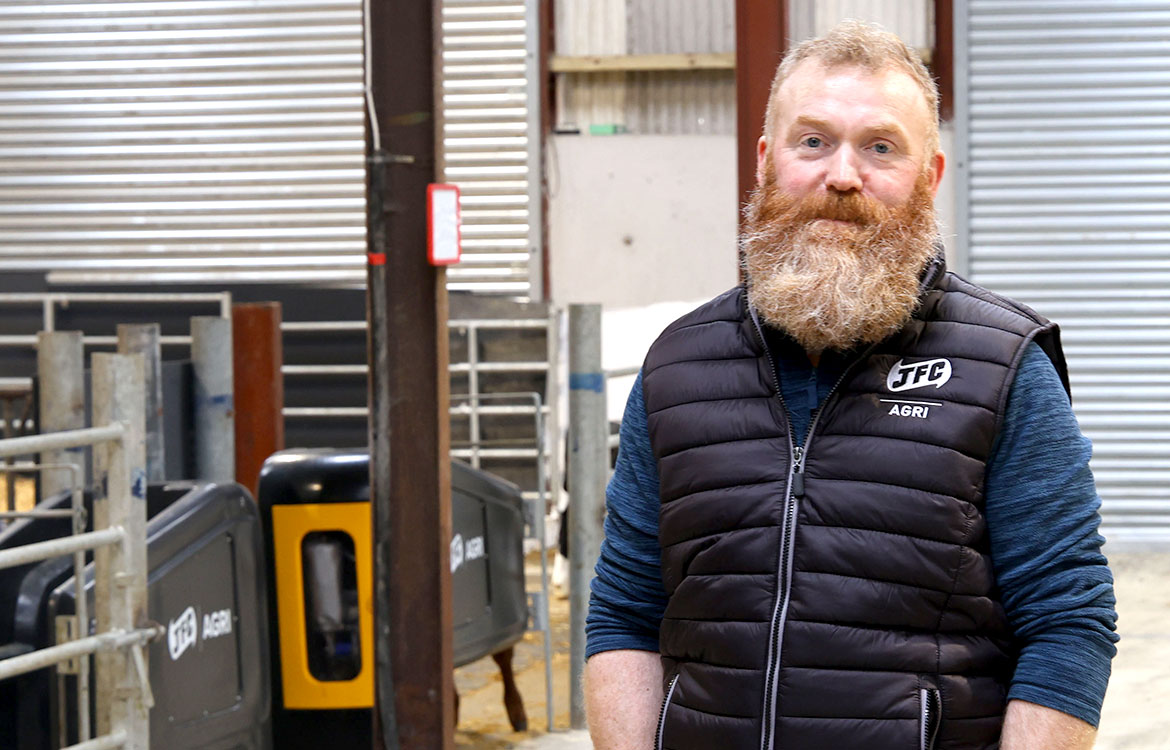
To remove that volatility, Paddy O'Hanlon introduced a JFC Evolution Automatic Calf Feeder into his rearing system. On his farm in Tarbert, County Kerry, he milks 140 cows and rears both dairy and beef calves, with 90% of his herd calving over a six week period. Rather than dedicating hours to manual feeding every day, the automatic calf feeder allows calves to essentially feed themselves throughout the day, while tracking the intake at individual calf level.
Calves move onto the automated system within four to five days, with milk intakes and weaning managed through a clear feeding curve on the screen. The system shows which calves have fed and flags any that fall behind, making it easier to identify issues early and respond before they escalate.
Rather than responding to noise in the shed, Paddy can make decisions based on what the system shows He has better oversight while dedicating a fraction of the time to feeding calves.
On Paddy's farm, the calving season isn't a year-round endeavour. Approximately 90% of the cows calve within a six-week period, which means large numbers of calves need to be fed and monitored at the same time, all while cows are calving. When that volume arrives all at once, a rigid feeding routine quickly becomes a bottleneck.
Paddy found that calves could be introduced to the automatic calf feeder within four to five days. From there, calves are free to visit the feeder whenever they choose, rather than being fed at fixed times. Each calf is recognised individually by the system, which controls how much milk it can receive and tracks how much it has already taken.
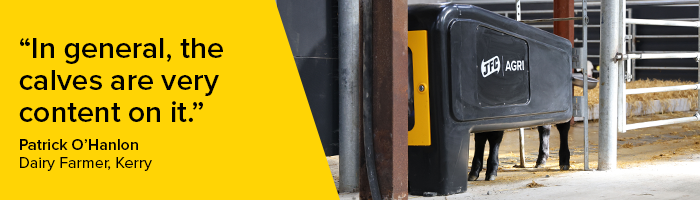
Because feeding is spread naturally across the day, calves feed when they are most ready, and demand doesn't peak all at once. As more calves arrive during the calving block, they slot into the same routine without adding extra feeding jobs or increasing pressure in the shed. Paddy can see intake data for every calf on screen, giving him confidence that feeding is always ocnsistent, even as numbers rise quickly.
Weaning is one of the points Paddy pays closest attention to, particularly when managing large groups of calves. With manual weaning, milk reductions depend on time and judgement. Stronger calves can push for a bigger share, while others may drink less or lose interest sooner, making intake uneven across the group.
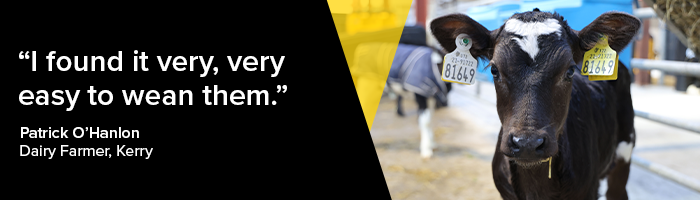
With automatic feeding, each calf is recognised individually using RFID technology and receives its specific allowance. Milk volulmes are reduced gradually along a set feeding curve. Because calves can feed when they choose, those reductions happen quietly without interrupting the routine and causing stress.
As Paddy puts it, "If anything, the feeder would have been better than myself at weaning the calves."
He can see exactly where each calf is on the curve and, if needed, extend the process for individuals that would benefit from extra time. From his experience using the automatic calf feeder, calves remain settled through weaning and continue to progress without the disruption that can come with uneven intake.
Paddy rears both dairy and beef calves, and he uses different feeding curves to reflect the needs of each. Rather than running all calves across a single feeding programme, calves are assigned to curves based on their type and performance. This can all be done from the HMI touchscreen on the unit in a matter of minutes.
In practice, Paddy explains that he often assigns beef calves a higher portion of milk pwder, with dairy stock following a different curve. Where needed, he can also extend the feeding period for individual calves, without changing the programme for the rest of the group. "That is very handy for each individual calf and individual breed," he says.
The result is that calves are continually thriving, from the moment they start on the feeder to long after they're weaned. And crucially, it hasn't reduced Paddy's time in the calf shed. Instead it has changed how that time is used. "It's not that I'm spending less time in the calf shed," he says, "but that time is being used to look after the younger stock, which I think will benefit me going forward."
With calves feeding freely throughout the day, Paddy no longer needs to be physically present at every feed to know that they are behaving. Instead, he uses the HMI touchscreen as the first point of reference when checking on the herd.
The unit's simple traffic light system gives him a clear overview of feeding activity. Calves that have fed appear on screen with a green tick next to them, while those that haven't taken their full allowance get an amber sign, and if a calf hasn't drunk, it's flagged with a red cross, which indicates to Paddy that he might need to take a closer look.
This level of detail is invaluable over the six week calving block. Plus, the routine suits his calves. They're quieter and calmer compared to when he used previous feeding methods where demand builds between feeds. Instead of checking every calf the same way every day, Paddy can identify the few that need attention and act early. It's a more targeted way to manage calf health and progress.
After-sales support was a key consideration for Paddy before installing the automatic calf feeder. Ahead of his decision, he spoke with other farmers already using the system, and the feedback was consistent.
"Before I bought, I was chatting to people...and that was one thing they all said that there was great backup with the JFC", says Paddy. That support was tested during the season when he ran into an issue with one of the feeding stations late in the evening.
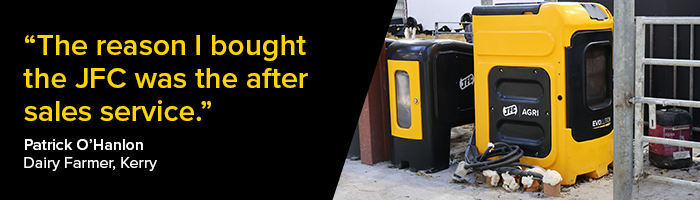
"I came down here at half nine and there was some problem with one of the stations and I couldn't get it going. I just rang the helpline number and I thought no one would get back to me." The response was immediate. "Within 10 minutes someone phoned and within half an hour we had the feeder up and running again. There was a serivce man out then the following day just to make sure it was all going right."
For Paddy, that level of backup makes a real difference when the system is relied on every day. "The help and backup is there if you need it from JFC."
In his second season using the automatic calf feeder, Paddy has seen it hold up during two high-pressure calving blocks. As the numbers rise, feeding and progress remain consistent. Calves settle quickly, wean seamlessly, and thrive once they reach the end of the block. Plus, the support is available whenever it's needed.
Feeding at scale: Calves are introduced within four to five days, allowing large numbers to use the system during the calving season.
Controlled weaning: Individual feeding curves reduce milk gradually, alleviating stress through weaning.
Clear oversight: Intake is tracked calf by calf, with the traffic light system highlighting issues early.
Flexible setup: Separate curves allow Paddy to manage dairy and beef calves individually without disrupting the group.
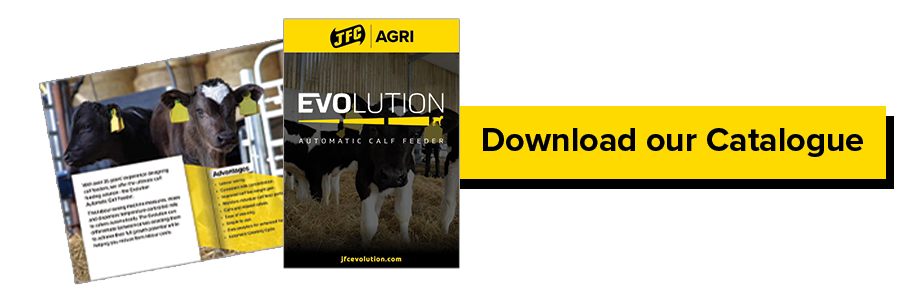
Are you considering a move to Automatic Calf Feeding?
Tuam, Co. Galway,
H54 RX46, Ireland
+353 93 24066
Maesbury rd, Oswestry,
SY10 8NN, UK
+44 16913 20003
info@jfcevolution.com