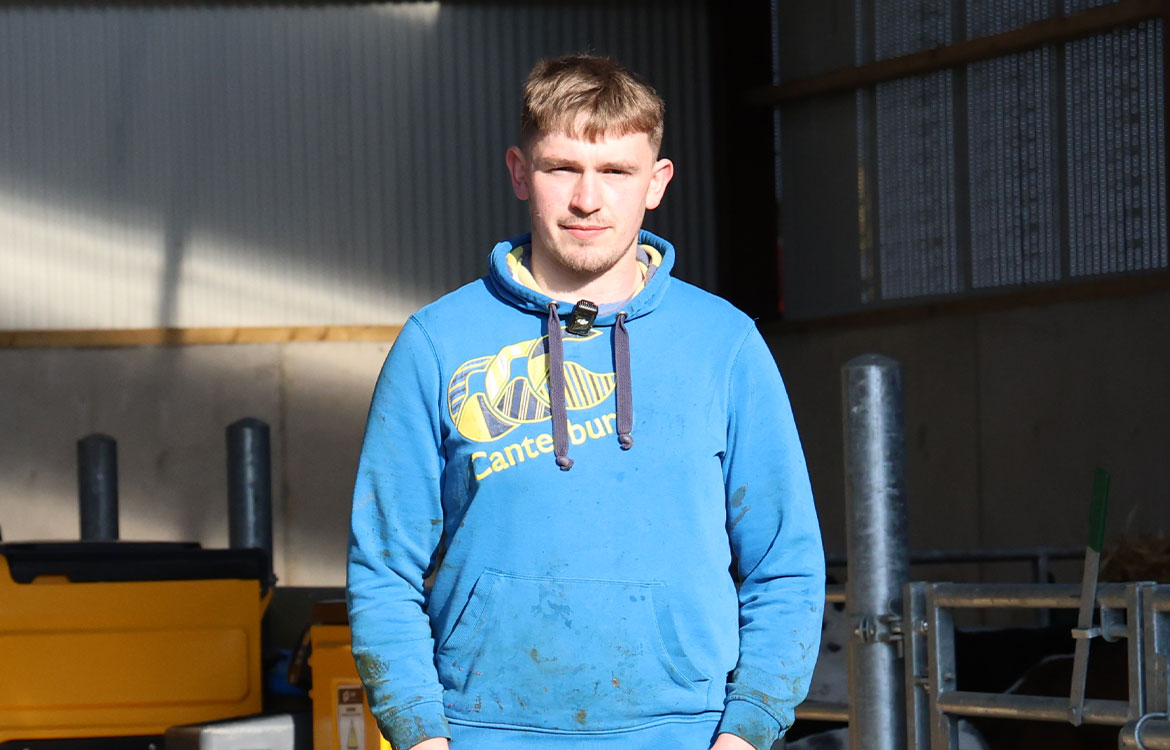
At his farm in Ballyouskill in County Kilkenny, Michael Brophy wanted more than a new way of feeding calves. Improving rearing was never going to be a guesswork decision. He wanted better calves, full stop. And this meant doing his research.
Before deciding on a system, Michael spoke to neighbouring farmers already using automatic feeders and looked closely at the results they were getting. The main thing that stood out aside from just the convenience, was the quality of the calves being reared on the JFC Evolution Automatic Calf Feeders.
"We looked around on multiple farms," Michael says. "Seeing how handy it is to rear calves, how well the calves do on them, how they thrive, how the calves are easily fed." With that in mind, he built his new calf shed around the installation of an Evolution S4, aiming for a setup that would give his own calves the same strong start.
The impact was immediate. "The quality of the calves is after improving massively," he explains. "Their coats are way shinier. The're just a step up in fariness."
When Michael built the new calf shed, the automatic calf feeder was part of the plan from the beginning. "We purposely built the sheds around the feeders," he states, so the layout wouyld suit both the heifer calves they rear on the farm and the beef calves they finish or sell later in the year.
Working with is local JFC sales representative, Michael could see how the system would be set up especially for the cattle moving through his shed. This support helped match the system to the way he wanted to rear the calves on the farm.

Even early on, the setup has proven itself to be a valuable addition. Calves adjust to the routine quickly, feeding becomes consistent across the board, and they thrive from day one, which is exactly what he hoped to achieve when installing the automatic calf feedere as part of the new build.
An early sign that the automatic calf feeder was having an impact was the lift in calf condition. The change wasn't necessarily gradual or subtle. It was obvious in their behaviour, their appearance, and how evenly they were progressing, even after weaning.
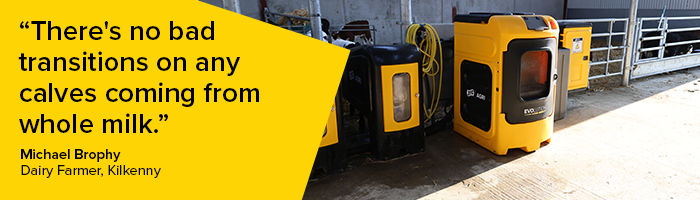
"The calves are taking to it very well, they're thriving on it...the calves look very healthy...you'd see it," Michael notes. "There's no bad transitipons and any calves say coming from whole milk onto the powder, they're happy."
Feeding is predictable and balanced, with each calf getting its allocation without being pushed aside. "There's no calf being bullied back from the feeder," Michael explains. "Everything is getting a certain amount of milk...they're not getting any more or any less, so there's no calves growing fierce weak or small."
Calves typically need to be encouraged once or twice before they're fully used to the system. Since each calf gets a set allocation and is free to drink when they need it, they grow at consistent rates. Michael now sees batches that are evenly sized, progressing together.
These early gains have made the rearing period more predictable and controlled, while removing stress from both the calves and workers.
Before installing the automatic calf feeder, the routine at the Ballyouskill farm meant hauling 13 or 14 buckets of milk across the yard every day. Many dairy farmers can relate to this time-consuming, repetitive work, especially during busy periods, like spring calving. "It was nonsense really," Michael says. "It was a lot of hardship."
Now, feeding has been reduced to a far simplet routine. Instead of moving buckets back and forth, Michael loads the powder, checks the feeder morning and evening, and uses the saved hours to stay ahead of other jobs arouind the yard.
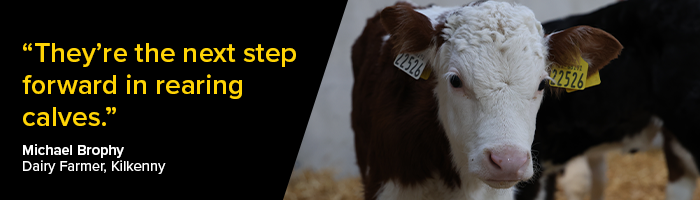
"You're in earlier in the evenings, you're relaxed," Michael reports. "You're not panicking about trying to get calves fed or hold back enough milk out of the tank."
The system also eliminates the unpredictability that used to come with group feeding. There's no rusihng, pushing, or stronger calves taking more than their share. Each one receives exactly what it's meant to get, and the rest of the rearing process becomes much easier to manage.
What once required consistent handling and manual effort is now a structured, dependable part of the day. The automatic calf feeder delivers consistency, and the time saved is felt across the rest of the farm.
For Michael, the reassurance that support is always available has been a major part of the move to automation. With multiple service technicians on the road and a dedicated phone number attached to each unut, help has been easy to access whenever needed. "There's always someone there to come out, give us a call, give us help," he says. "We're not stuck waiting for calves to be fed."
The one issue he encountered was resolved quickly over the phone. "We just rang him up and he answered straight away and talked us through our problem. There was no need for a callout...within half anou hour we were back up and going again." The round the clock availabilty offers peace of mind during the busiest part of the year, when delays simply aren't an option.
With the automatic calf feeder, you also get support through online videos and information, accessible via a QR code. Scanning the code links you to a variet of materials on everything from registering calves to washing the teats. It means Michael can get clear instructions instantly, without waiting on anyone else. "It gives you everything you need to know about the machine," he says. "You could run it yourself."
Together, the on-call assistance and self-help resources ensure the system never becomes a bottleneck, and that whoever is on the farm can keep it offering without issue.
Since installing the automatic calf feeder, Michael Brophy has seen the routine become more predictable and the calves progress exceptionally. Weaning transitions are sealess, health issues are easier to spot, and every calf gets exactly what it needs wihtout competition or missed feeds. What began as an upgrade to the farm has now become a core part of how calves are reared on the farm.
Even batches: Calves grow at consistent rates wtih no bullying.
Health visibility: Clear indicators highlight missed feeds or early signs of illness.
Smoother transitions: Calves adjust quickly to the system and move through weaning without stress.
Daily reliability: Automated feeding frees up time and reduces pressure during busy periods.
Are you considering a move to Automatic Calf Feeding?
Tuam, Co. Galway,
H54 RX46, Ireland
+353 93 24066
Maesbury rd, Oswestry,
SY10 8NN, UK
+44 16913 20003
info@jfcevolution.com