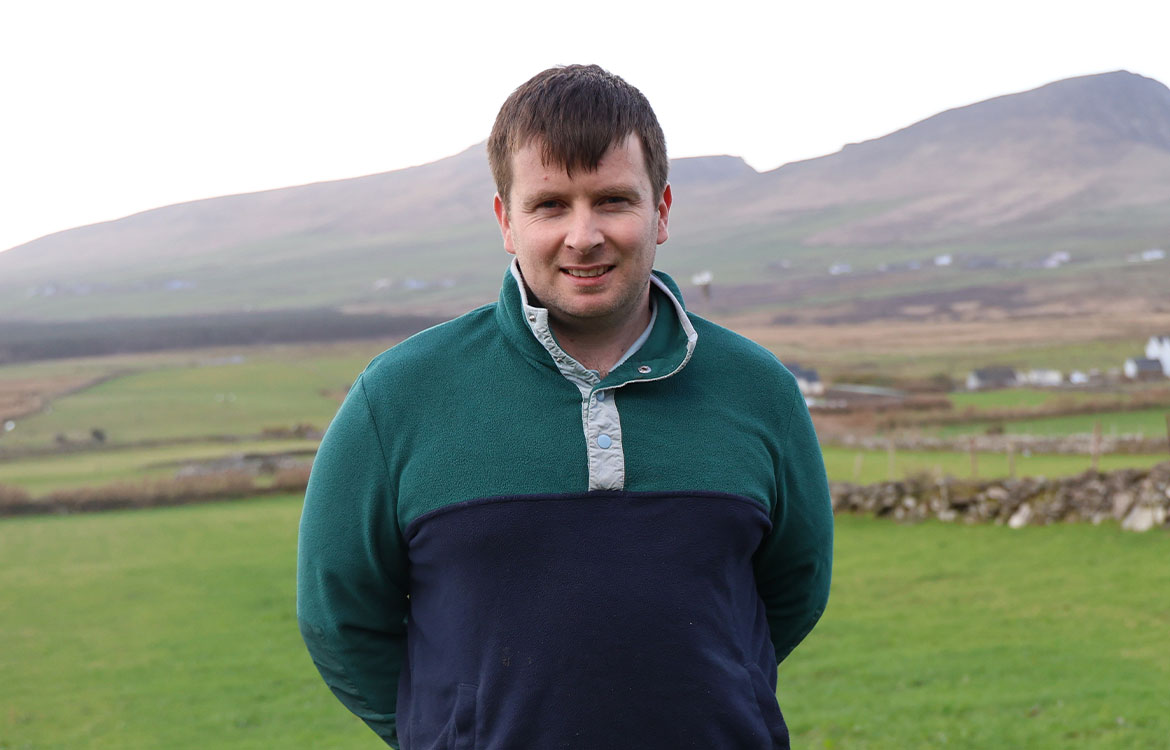
On the werstern side of the Dingle Peninsula, Diarmuid Begley and his father rear bought-in dairy calves while both working full-time off-farm. Balancing work with early-season calf care was always demanding, especially when traditional bucket feeding stretched into long, uneven routines. Three years ago, they brought in the JFC Evolution S2 Automatic Calf Feeder to bring more structure to the job, and the difference has been clear every season since.
What stands out most is how the system has changed the feel of the shed. Isntead of calves roaring for feed or bunching at the gate, Diarmuid now walks into a space that is calm, settled, and predictable. Even at weaning, the transition happens so smoothly that they sometimes don't realise the calves are fully off milk.
Consistency has followed right through the batches they rear. Buying calves from different farms often meant dealing with variations in feeding history and growth, but the automatic calf feeder has given every calf the same start and the same access to milk. The result is a noticeable more even group, which is something Diarmuid says made a real impact this year, especially with strong cattle prices.
Three seasons in, automation is now a key part of how the father and son manage labour, health, and daily routine.
Because the Begleys buy calves from multiple dairy farms, their batches can vary in age, background, and feeding history when compared to a more traditional large spring calving herd. Despite that, the calves settle onto the automatic calf feeder with very little fuss. A few need encouragement once or twice, but after that, they return on their own and slot naturally into the routine.
This year, the results have been especially clear. "All the calves were a very, very even bunch," he says. With dairy farms often feeding whole milk, transitions can be a challenge, yet the consistency of automatic feeding has kept every calf moving forward at the same pace.
Even after a year of strong calf prices, the quality stands out. Calves are uniform, thriving, and ready to sell in larger, more valuable groups. Where teat buckets once led to dominant calves getting more than their share, the automatic calf feeder ensures balance. Every calf receives its correct allocation, which removes the highs, lows, and setbacks that usually appear in bought-in groups.
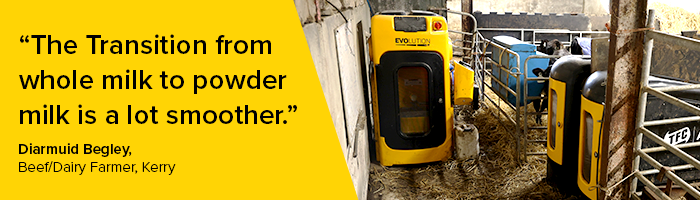
A big part of Diarmuid's routine is helping calves settle quickly once they arrive on the farm. Many of them come from herds feeding whole milk, so the feeder's additive dispenser has become a useful tool in those first few weeks. By putting it directly through the feeder, the transition onto powder is controlled and steady, meaning calves continue to thrive without dipping in condition.
A big part of Diarmuid's routine is helping calves settle quickly once they arrive on the farm. Many of them come from herds feeding whole milk, so the feeder's additive dispenser has become a useful tool in those first few weeks. By putting it directly through the feeder, the transition onto powder is controlled and stready, meaning calves continue to thrive without dipping in condition.
Hygiene has also improved with the automatic calf feeder. Diarmuid notes how the system washes the teat and collects water, keeping the area clean throughout the day. He still disinfects and rotates teats in the evenings, but the automatic wash makes sure hygiene standards are high when the shed is at its busiest.
And with each feed monitored, Diarmuid can flag small issues before they're visible in the calves. "We used to be looking at the calves and saying there's nothing wrong with that calf ath the moment," he says, "within maybe 12 hours that calf might have a touch of scour." Now, a missed or reduced feed shows up straight away, giving him a chance to intervene earlier and reduce antibiotic use throughout the year.
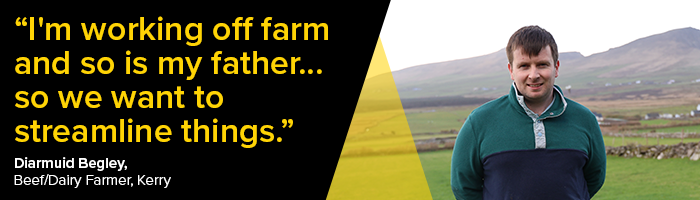
For Diarmuid and his father, labour saving was one of the key factors in moving to automation. Since both work off-farm, time is limited, and traditional feeding meant anywhere from an hour to two hours in the shed per session, depending on bedding and other jobs. Now, instead of mixing milk and managing groups, their routine starts with a quick look at the control unit or the mobile app to see which calves have drunk and which might need to be pushed on.
Calves can now drink their allocation when they want it, even splitting feeds across multiple feedings if they're full. Instead of having to organise their day around feeding times, the Begleys can monitor the calves from anywhere and intervene when it's necessary.
But the reality is that this flixbility only works if the system is backed by dependable support. Even in a remote area, west of Dingle, Diarmuid knows help is always available. The number printed on the machine connects him to support at any time, and most issues are solved on the phone, long before a callout would ever be needed. But should the automatic calf feeder require hands-on work, technicians are available for callouts around the clock.
After three seasons with the automatic calf feeder, the Begleys have a rearing system that runs reliably alongside their off-farm jobs. The biggest gains have come from consistency: calves settle quickly, routines stay predictable, and the information on the feeder allows issues to be caught sooner and with far less stress.
Even, consistent groups: Calves develop as a uniform batch, without big size gaps caused by stronger calves pushing ahead.
Earlier illness detection: Missed or reduced feeds show up immediately, giving them hours of extra notice before symptoms appear.
Smoother feeding transitions: Additives and controlled allocations help calves move from whole milk to powder without dipping in condition.
Labour savings every day: What used to take one to two hours is now a quick check on the control unit or app, fitting easily around off-farm work.
Are you considering a move to Automatic Calf Feeding?

Tuam, Co. Galway,
H54 RX46, Ireland
+353 93 24066
Maesbury rd, Oswestry,
SY10 8NN, UK
+44 16913 20003
info@jfcevolution.com